Packing
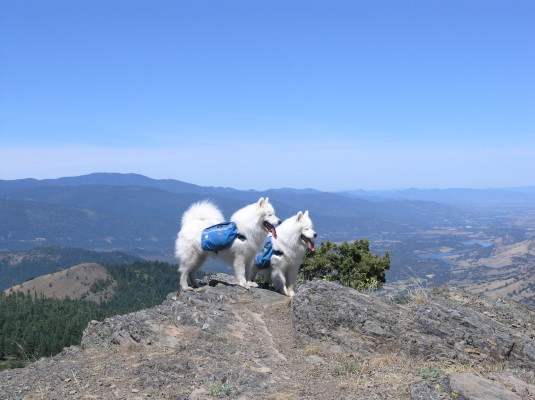
The beauty of pack hiking is that you have so many options for having a great time with your best friend. You can do it almost anywhere, set your own schedule, go alone or with a group, go around the park or up the mountain, make it easy or difficult, long or short, a day or afternoon hike or a three week trek.
Starting out is fairly simple. I do not recommend taking a dog hiking without any training. As a young dog, try putting a towel on the dog’s back and pinning it underneath his belly and walking him on a leash, so that he can get used to the feeling of something on his back. Then, progress. Try the empty packs on your dog and walk him a bit so he can get used to the feel. Most of the time he will hardly notice. If all goes well, add a few items in the pack (an eighth of the dog’s weight or so) just to familiarize him with both the extra poundage and the bulk. The packs should ride forward toward the dog’s shoulders rather than back toward the loins. This is a very important step as you do not want to injure the dogs spine.
It helps tremendously if your dog has been trained to walk nicely on lead. If not, a head collar will allow you both to enjoy your hike. Try some short hikes of a couple of miles with a light load until you both are feeling conditioned for longer trips. Your dog can earn points for the SCA working degrees with hikes of 5 miles or more. I am a great fan of using a walking belt while hiking. It allows the dog to be out front and allows your hands to be free to be able to climb or take pictures. My personal favorite is the White Pines High Sierra Walk-a-Belt, www.whitepineoutfitters.com, but an easy search on the internet for “hands free dog hiking belt” will give you many more options.
You can buy packs at most good outfitters. Choosing a pack is a personal preference. Some prefer packs that have a saddle separate from the actual pack. The pack stays put on the saddle with velcro bars. This allows the packs to be removed for rests or lunch stops without having to unstrap the saddle as well. Remember, ultimately the dog must be able to carry 25% of their body weight so a well-constructed pack is critical. Some great sites to check out are www.wolfpacks.com and www.backpackdogs.com, the latter providing some additional information about packs.
 Always keep your dog on lead (a six foot leather lead is best) for your dog’s safety and the safety of wildlife and other hikers. Most public trails require that you honor this responsibility and I cannot stress the importance of doing so too strongly. People who ignore this regulation and common courtesy are contributing to the closure of trails to hikers with dogs. Other trail users have stopped me many times to thank me for having the dogs under control. Some obedience training helps. When you meet other hikers, stop off the trail to let them pass. They will appreciate the courtesy and they will be impressed with you and your dogs. It is very important that you remember the phrase, “Leave no tracks behind” meaning, respect the trails. If your dog goes to the bathroom, you must either pick it up or bury it. In addition to poop bags I recommend carrying in the dogs pack a little shovel of the garden variety will work and or a Tupperware like container to put the “used” poop bag into so that you don’t need to carry it or so that the smell doesn’t “contaminate” everything else in your pack until you reach a garbage can.
Your dog should carry in his pack:
- Water (and a small pan if your dog does not drink out of a bottle). This is essential. You will be amazed at how much your dog will drink, even on a cool day. For a ten mile hike, carry at least 5 pounds of water. Stop after the first 20 minutes or so to see if the dog wants a drink, and every half an hour afterward. To make sure your dog is hydrated, you might try watering him an hour or so before you leave, baiting the water with something tasty to encourage him to drink. Watch for signs of thirst: a tongue hanging to the ground and excessive panting means you’re waiting too long to water the dog.You will use up the water as you hike. The Working Samoyed Program does not require you to replace the weight as you go; however, this does not mean that you can dump the water after hiking a while just to lighten the load. It has to be to used up naturally.
- Booties. Your dog may scrape, cut or bruise his pads. Check the feet often. The booties can make the difference between a fun hike and a bad day. I find that once the dog is seasoned to hiking this option is a matter of choice and location of the hike.
- Other items your dog can carry include dog snacks, extra leashes, extra line to help cross streams, a small first aid kit (for humans and dogs), small binoculars, small cameras, sample bags of dog food, and small towels that can be used as pads between the harder items and the dog’s sides. Put anything that should not get wet in a ziplock bag.
Be sure to balance the pack by attempting to have the same weight on both sides. Pack a number of smaller items rather than a few large ones so that you can redistribute weight if the pack becomes unbalanced. It will inevitably do so as your dog drinks his water.
Suggestions for the human member of the hiking team:
- Wear good hiking boots and socks. Unless you want sore feet and twisted ankles, light walking shoes or sneakers are acceptable only for short walks on very flat, very well groomed trails. Good hiking socks are worth their weight in gold for preventing blisters.
- Wear a hat with a brim for eye and skin protection, and warmth on a cool day.
- Carry at a minimum a rain jacket, a warm layer, lunch, compass, maps, a small knife, extra plastic bags, and sun screen. For longer hikes and hikes into wilderness areas, you might add gloves, a space blanket, and matches. GPS devices are good if you know how to use them, but cell phones often do not have service in wilderness areas.
Where to go
Many hiking opportunities abound, even around and in large cities. Check county, city and state parks and forests, local cross country ski or snowmobile trails (in non-snow seasons, of course) and national forests. Your city, county and state offices and even your local Chambers of Commerce will have information on these. This information can also usually be found on all their websites. An excellent source is your state Department of Natural Resources or Game and Fish Department (they have different names in different states.) National Parks do not allow dogs on the trails on all of their trails; check before you go.
There are several publications out now that identify trails in specific areas that are dog friendly, such as Best Hikes With Dogs Colorado (Best Hikes With Dogs Colorado) by Ania Savage (Paperback – April 15, 2005).
Any of the big internet booksellers can help you find something for your area if it is available.
-By Pam Landers, Revised by Chris DuBois 2013
Books on packing
Backpacking With Your Dog, Charlene LaBelle, Alpine Publications, Loveland, CO, 1993
On the Trail With Your Canine Companion: Getting the Most of Hiking and Camping With Your Dog by Cheryl S. Smith, April 1, 1996
The Canine Hiker’s Bible by Doug Gelbert, September 30, 2000